Garnets ( /ˈɡɑːrnɪt/) are a group of silicate minerals that have been used since the Bronze Age as gemstones and abrasives.
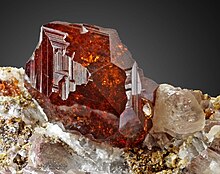

All species of garnets possess similar physical properties and crystal forms, but differ in chemical composition. The different species are pyrope, almandine, spessartine, grossular (varieties of which are hessonite or cinnamon-stone and tsavorite), uvarovite and andradite. The garnets make up two solid solution series: pyrope-almandine-spessartine (pyralspite), with the composition range [Mg,Fe,Mn]3Al2(SiO4)3; and uvarovite-grossular-andradite (ugrandite), with the composition range Ca3[Cr,Al,Fe]2(SiO4)3.
Etymology
The word garnet comes from the 14th-century Middle English word gernet, meaning 'dark red'. It is borrowed from Old French grenate from Latin granatus, from granum ('grain, seed').[3] This is possibly a reference to mela granatum or even pomum granatum ('pomegranate',[4] Punica granatum), a plant whose fruits contain abundant and vivid red seed covers (arils), which are similar in shape, size, and color to some garnet crystals.[5] Hessonite garnet is also named 'gomed' in Indian literature and is one of the 9 jewels in Vedic astrology that compose the Navaratna.[citation needed]
Physical properties
Properties
Garnet species are found in every colour, with reddish shades most common. Blue garnets are the rarest and were first reported in the 1990s.[6][7][8][9]

Garnet species' light transmission properties can range from the gemstone-quality transparent specimens to the opaque varieties used for industrial purposes as abrasives. The mineral's luster is categorized as vitreous (glass-like) or resinous (amber-like).[3]
Crystal structure

Garnets are nesosilicates having the general formula X3Y2(SiO
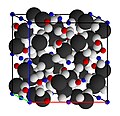
4)3. The X site is usually occupied by divalent cations (Ca, Mg, Fe, Mn)2+ and the Y site by trivalent cations (Al, Fe, Cr)3+ in an octahedral/tetrahedral framework with [SiO4]4− occupying the tetrahedra.[10] Garnets are most often found in the dodecahedral crystal habit, but are also commonly found in the trapezohedron habit as well as the hexoctahedral habit.[3] They crystallize in the cubic system, having three axes that are all of equal length and perpendicular to each other, but are never actually cubic because, despite being isometric, the {100} and {111} families of planes are depleted.[3] Garnets do not have any cleavage planes, so when they fracture under stress, sharp, irregular (conchoidal) pieces are formed.[11]


Hardness
Because the chemical composition of garnet varies, the atomic bonds in some species are stronger than in others. As a result, this mineral group shows a range of hardness on the Mohs scale of about 6.0 to 7.5.[12] The harder species like almandine are often used for abrasive purposes.[13]
Magnetics used in garnet series identification
For gem identification purposes, a pick-up response to a strong neodymium magnet separates garnet from all other natural transparent gemstones commonly used in the jewelry trade. Magnetic susceptibility measurements in conjunction with refractive index can be used to distinguish garnet species and varieties, and determine the composition of garnets in terms of percentages of end-member species within an individual gem.[14]
Garnet group end member species
Pyralspite garnets – aluminium in Y site
- Almandine: Fe3Al2(SiO4)3
- Pyrope: Mg3Al2(SiO4)3
- Spessartine: Mn3Al2(SiO4)3


Almandine
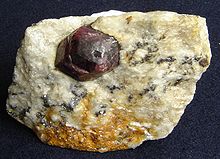
Almandine, sometimes incorrectly called almandite, is the modern gem known as carbuncle (though originally almost any red gemstone was known by this name).[15] The term "carbuncle" is derived from the Latin meaning "live coal" or burning charcoal. The name Almandine is a corruption of Alabanda, a region in Asia Minor where these stones were cut in ancient times. Chemically, almandine is an iron-aluminium garnet with the formula Fe3Al2(SiO4)3; the deep red transparent stones are often called precious garnet and are used as gemstones (being the most common of the gem garnets).[16] Almandine occurs in metamorphic rocks like mica schists, associated with minerals such as staurolite, kyanite, andalusite, and others.[17] Almandine has nicknames of Oriental garnet,[18] almandine ruby, and carbuncle.[15]
Pyrope
Pyrope (from the Greek pyrōpós meaning "firelike"[3]) is red in color and chemically an aluminium silicate with the formula Mg3Al2(SiO4)3, though the magnesium can be replaced in part by calcium and ferrous iron. The color of pyrope varies from deep red to black. Pyrope and spessartine gemstones have been recovered from the Sloan diamondiferous kimberlites in Colorado, from the Bishop Conglomerate and in a Tertiary age lamprophyre at Cedar Mountain in Wyoming.[19]
A variety of pyrope from Macon County, North Carolina is a violet-red shade and has been called rhodolite, Greek for "rose". In chemical composition it may be considered as essentially an isomorphous mixture of pyrope and almandine, in the proportion of two parts pyrope to one part almandine.[20] Pyrope has tradenames some of which are misnomers; Cape ruby, Arizona ruby, California ruby, Rocky Mountain ruby, and Bohemian ruby from the Czech Republic.[15]
Pyrope is an indicator mineral for high-pressure rocks. Mantle-derived rocks (peridotites and eclogites) commonly contain a pyrope variety.[21]
Spessartine

Spessartine or spessartite is manganese aluminium garnet, Mn3Al2(SiO4)3. Its name is derived from Spessart in Bavaria.[3] It occurs most often in skarns,[3] granite pegmatite and allied rock types,[22] and in certain low grade metamorphic phyllites. Spessartine of an orange-yellow is found in Madagascar.[23] Violet-red spessartines are found in rhyolites in Colorado[20] and Maine.[citation needed]
Pyrope–spessartine (blue garnet or color-change garnet)
Blue pyrope–spessartine garnets were discovered in the late 1990s in Bekily, Madagascar. This type has also been found in parts of the United States, Russia, Kenya, Tanzania, and Turkey. It changes color from blue-green to purple depending on the color temperature of viewing light, as a result of the relatively high amounts of vanadium (about 1 wt.% V2O3).[8]
Other varieties of color-changing garnets exist. In daylight, their color ranges from shades of green, beige, brown, gray, and blue, but in incandescent light, they appear a reddish or purplish/pink color.[citation needed]
This is the rarest type of garnet. Because of its color-changing quality, this kind of garnet resembles alexandrite.[24]
Ugrandite group – calcium in X site
- Andradite: Ca3Fe2(SiO4)3
- Grossular: Ca3Al2(SiO4)3
- Uvarovite: Ca3Cr2(SiO4)3
Andradite
Andradite is a calcium-iron garnet, Ca3Fe2(SiO4)3, is of variable composition and may be red, yellow, brown, green or black.[3] The recognized varieties are demantoid (green), melanite (black),[3] and topazolite (yellow or green). Andradite is found in skarns[3] and in deep-seated igneous rocks like syenite[25] as well as serpentines[26] and greenschists.[27] Demantoid is one of the most prized of garnet varieties.[28]
Grossular


Grossular is a calcium-aluminium garnet with the formula Ca3Al2(SiO4)3, though the calcium may in part be replaced by ferrous iron and the aluminium by ferric iron. The name grossular is derived from the botanical name for the gooseberry, grossularia, in reference to the green garnet of this composition that is found in Siberia. Other shades include cinnamon brown (cinnamon stone variety), red, and yellow.[3] Because of its inferior hardness to zircon, which the yellow crystals resemble, they have also been called hessonite from the Greek meaning inferior.[29] Grossular is found in skarns,[3] contact metamorphosed limestones with vesuvianite, diopside, wollastonite and wernerite.
Grossular garnet from Kenya and Tanzania has been called tsavorite. Tsavorite was first described in the 1960s in the Tsavo area of Kenya, from which the gem takes its name.[30][31]
Uvarovite
Uvarovite is a calcium chromium garnet with the formula Ca3Cr2(SiO4)3. This is a rather rare garnet, bright green in color, usually found as small crystals associated with chromite in peridotite, serpentinite, and kimberlites. It is found in crystalline marbles and schists in the Ural mountains of Russia and Outokumpu, Finland. Uvarovite is named for Count Uvaro, a Russian imperial statesman.[3]
Less common species
- Calcium in X site
- Goldmanite: Ca3(V3+,Al,Fe3+)2(SiO4)3
- Kimzeyite: Ca3(Zr, Ti)2[(Si,Al,Fe3+)O4]3
- Morimotoite: Ca3Ti4+Fe2+(SiO4)3
- Schorlomite: Ca3(Ti4+,Fe3+)2[(Si,Ti)O4]3
- Hydroxide bearing – calcium in X site
- Hydrogrossular: Ca3Al2(SiO4)3-x(OH)4x
- Hibschite: Ca3Al2(SiO4)3-x(OH)4x (where x is between 0.2 and 1.5)
- Katoite: Ca3Al2(SiO4)3-x(OH)4x (where x is greater than 1.5)
- Hydrogrossular: Ca3Al2(SiO4)3-x(OH)4x
- Magnesium or manganese in X site
- Knorringite: Mg3Cr2(SiO4)3
- Majorite: Mg3(Fe2+Si)(SiO4)3
- Calderite: Mn3Fe3+2(SiO4)3
Knorringite
Knorringite is a magnesium-chromium garnet species with the formula Mg3Cr2(SiO4)3. Pure endmember knorringite never occurs in nature. Pyrope rich in the knorringite component is only formed under high pressure and is often found in kimberlites. It is used as an indicator mineral in the search for diamonds.[32]
Garnet structural group
- Formula: X3Z2(TO4)3 (X = Ca, Fe, etc., Z = Al, Cr, etc., T = Si, As, V, Fe, Al)
- All are cubic or strongly pseudocubic.
- IMA/CNMNC – Nickel-Strunz – Mineral subclass: 09.A Nesosilicate
- Nickel-Strunz classification: 09.AD.25
- References: Mindat.org; mineral name, chemical formula and space group (American Mineralogist Crystal Structure Database) of the IMA Database of Mineral Properties/ RRUFF Project, Univ. of Arizona, was preferred most of the time. Minor components in formulae have been left out to highlight the dominant chemical endmember that defines each species.
Synthetic garnets
Also known as rare-earth garnets.
The crystallographic structure of garnets has been expanded from the prototype to include chemicals with the general formula A3B2(CO4)3. Besides silicon, a large number of elements have been put on the C site, including germanium, gallium, aluminum, vanadium and iron.[33]
Yttrium aluminium garnet (YAG), Y3Al2(AlO4)3, is used for synthetic gemstones. Due to its fairly high refractive index, YAG was used as a diamond simulant in the 1970s until the methods of producing the more advanced simulant cubic zirconia in commercial quantities were developed. When doped with neodymium (Nd3+), YAG may be used as the lasing medium in Nd:YAG lasers.[34] When doped with erbium, it can be used as the lasing medium in Er:YAG lasers. When doped with gadolinium, it can be used as the lasing medium in Gd:YAG lasers. These doped YAG lasers are used in medical procedures including laser skin resurfacing, dentistry, and ophthalmology.[35][36][37]
Interesting magnetic properties arise when the appropriate elements are used. In yttrium iron garnet (YIG), Y3Fe2(FeO4)3, the five iron(III) ions occupy two octahedral and three tetrahedral sites, with the yttrium(III) ions coordinated by eight oxygen ions in an irregular cube. The iron ions in the two coordination sites exhibit different spins, resulting in magnetic behavior. YIG is a ferrimagnetic material having a Curie temperature of 550 K. Yttrium iron garnet can be made into YIG spheres, which serve as magnetically tunable filters and resonators for microwave frequencies.[citation needed]
Lutetium aluminium garnet (LuAG), Al5Lu3O12, is an inorganic compound with a unique crystal structure primarily known for its use in high-efficiency laser devices. LuAG is also useful in the synthesis of transparent ceramics.[38] LuAG is particularly favored over other crystals for its high density and thermal conductivity; it has a relatively small lattice constant in comparison to the other rare-earth garnets, which results in a higher density producing a crystal field with narrower linewidths and greater energy level splitting in absorption and emission.[39]
Terbium gallium garnet (TGG), Tb3Ga5O12, is a Faraday rotator material with excellent transparency properties and is very resistant to laser damage. TGG can be used in optical isolators for laser systems, in optical circulators for fiber optic systems, in optical modulators, and in current and magnetic field sensors.[40]
Another example is gadolinium gallium garnet (GGG), Gd3Ga2(GaO4)3 which is synthesized for use as a substrate for liquid-phase epitaxy of magnetic garnet films for bubble memory and magneto-optical applications.[citation needed]